

4.2. Electricity#
Electricity is the movement of tiny charged particles called electrons. These particles normally sit still inside materials, but if we give them energy, they can flow.
You can think of electrons like water molecules in a pipe. When there is pressure pushing them, they move in one direction and this movement is what we call an electric current.
4.2.1. Conductors#
A conductor is a material that conveys electricity. Normally conductors are made out of metals as they are more “conductive” than other materials. Examples of conductors are:
wires that connect components
traces on printed circuit boards
4.2.2. Direct Current#
Current is the amount of electrons flowing through a conductor or circuit, similar to the amount of water moving in a pipe every second.
Different devices draw different amounts of current. For example sensors and microcontrollers use very little, while motors need a lot more current to create movement.
Current is measured in amperes (I), usually shortened to amps.
Most mechatronic systems use Direct Current (DC). With DC, electrons flow in one direction only, from the negative (-) side of a power source back to the positive (+) side. This is called “conventional current”.
Batteries supply DC, which is why we use them in our robots.
4.2.3. Polarity#
Polarity tells us which way the current flows. Positive (+) and negative (-) are marked on batteries and power connectors.
When attaching power connectors always match positive to positive and negative to negative. Otherwise you risk damaging the sensitive electronics on your devices or robots.
4.2.4. Voltage#
Voltage is the push that makes electrons flow, like water pressure in a hose. A higher voltage means a stronger push on the electrons. Devices need the right voltage to work.
Too low and the device won’t run.
Too high and components can overheat or burn out.
Voltage is measured in volts (V).
4.2.5. Resistance#
Resistance is how much a material opposes the flow of electricity. Every conductor (like copper wire) has some resistance, though good conductors keep it very low.
Higher resistance means it is harder for current to flow like a narrow pipe that slows down water.
Resistance causes some electrical energy to turn into heat. That’s why thin wires or poor connectors can get hot if too much current passes through them.
Resistance is measuring in ohms (R).
4.2.6. Ohm’s Law#
Resistance links voltage and current through Ohm’s Law:
If the resistance increases, the current decreases (for the same voltage).
If resistance decreases, the current increases.
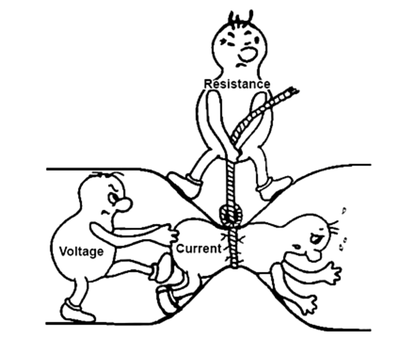
A handy way to remember Ohm’s Law!#
4.2.7. Circuits#
A circuit is a closed loop that lets electrons flow.
Open circuit is when the loop is broken (like a switch turned off).
Closed circuit means the loop is complete, and electricity flows (switch on).
Circuits typically contain multiple components placed:
in series, one after the other,
in parallel, side by side,
or using a combination of both.