

Binary Search Tree#
A binary search tree (BST) is a tree like data structure that is used for performing binary search. The core idea of a binary search tree is that binary search requires the data to be sorted first, which is time consuming, and it would be more efficient to store the data pre-sorted.
Note
Note that BSTs can only be used for data that is sortable. For the purposes of this lesson we assume that we are storing integers.
Recommended Video (6 minutes)#
Concept#
A BST is a tree where each node:
contains the data (key) for that node
references to two children:
leftandright
and satisfies the BST “invariant” rule at every node:
All values in the left subtree are less than the node’s data
All values in the right subtree are greater than the node’s data
We call a tree that has equal number of nodes to on the left and right sides “balanced”.
Visually, a small BST might look like:
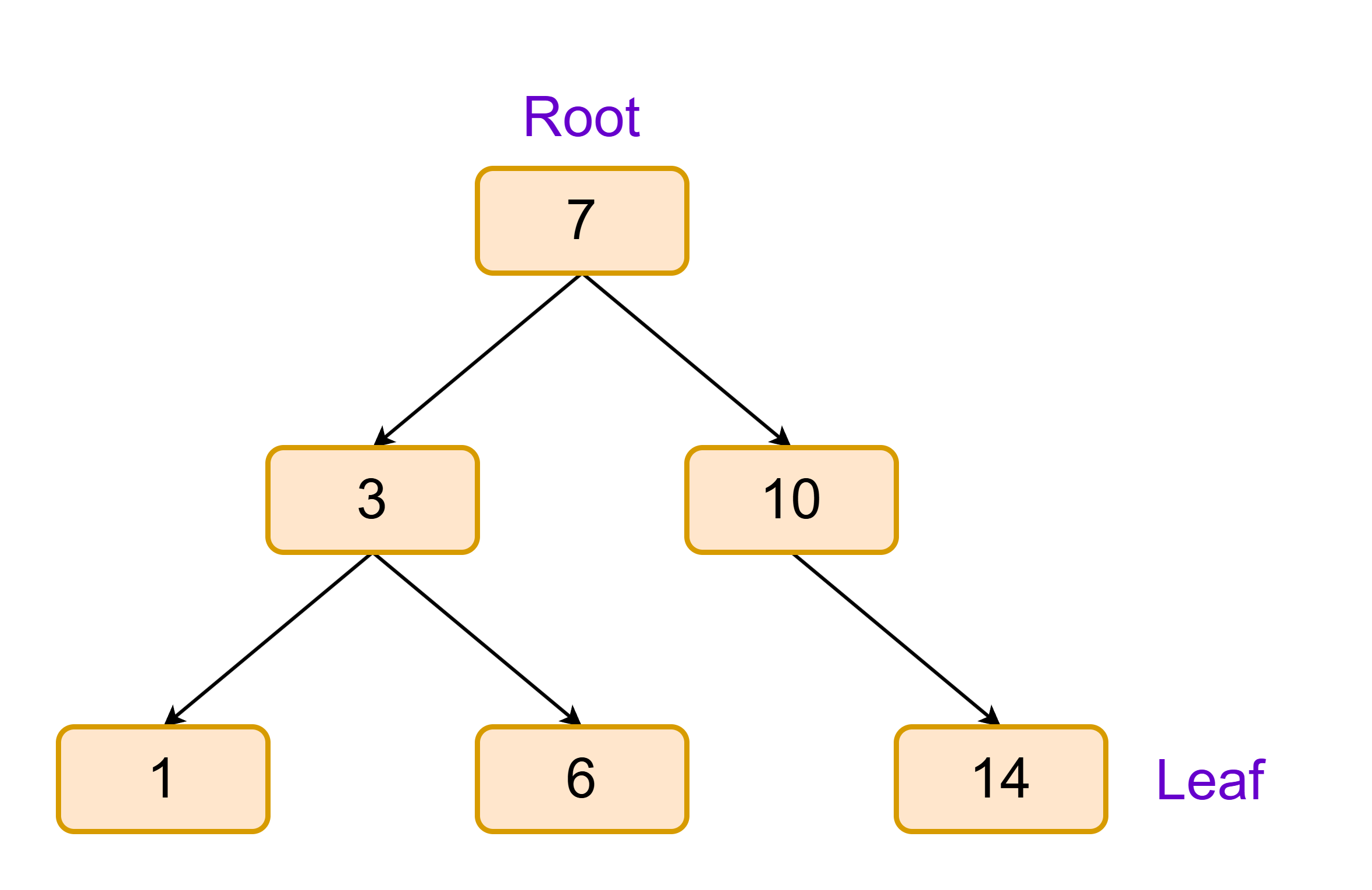
Here, for example, every value in the subtree under \(3\) is \(< 8>\), and every value under \(10\) is \(>8\).
Time Complexity#
Search
To search for a value (key) we start at the root node then recurse left or right depending on the value of the node. A sketch of this process is below:
def search(node, key):
    if key == node.data:
        return True        # found
    elif key < node.data:
        return search(node.left, key)
    else:
        return search(node.right, key)
Searching is just following a single path from the root to the leaf node. Therefore it takes \(h\) steps where \(h\) is the height of the tree. To determine the time complexity for searching we need to know how \(n\) relates to \(h\).
In a balanced tree with \(n\) elements the relationship is
Solving for \(h\):
Applying log rules
Applying Big-O rules we arrive at a time complexity of \(O(\log n)\).
Insertion and Deletion
To insert a new value (key) into or delete a value from the tree we complete a search. Therefore the time complexity is related to the height of the tree and is the same as searching.
To insert a new value (key) we do the following:
Start at the root.
Compare the new key k to
node.data.Recurse:
If
k < node.data, go left;If
k > node.data, go right.
Insert a new leaf node when you reach a
Nonespot.
To delete a value (key) we do the following:
Search until you find the value
Perform one of the following based on the situation
Leaf node: drop the key from the tree by setting its parent to None
One child: assign the child to the target parent’s left or right node
Two children:
Find the target’s successor or predecessor
Overwrite the target value with successor/predecessor value
Delete successor/predecessor
Space Complexity#
A BST stores exactly one node per element, and each node holds:
The data value
Left child reference
Right child reference
Therefore total memory requirements are \(3 \times n\) pieces of data. This simplifies to \(O(n)\).
Code Challenge: Binary Search Tree
Using the modified Node class provided, complete the BinarySearchTree class. This class will only support insertion and searching.
BinarySearchTree Specifications
Attributes
root, a reference to the rootNodeof the tree
Methods
insert(self, key), to insert thekeyinto the treesearch(self, key), returnsTrueifkeyis in the tree,Falseotherwise
Each of these methods needs to recursively search, which is handled by “private” methods (starting with _).
Instructions
Note
Look for the TODO items in the provided code!
Check the new
Nodeclass, it now hasleftandrightattributes for child nodesComplete the recursive
_search_rec(self, node, key)method to handle the casesnodeisNone: returnFalsesince we reached the end of a branch and did not find thekeynode.datamatcheskey: returnTruesince we found a matchnode.data > key: recurse to the rightnode.data < key: recurse to the left
Usage Example
>>> bst = BinarySearchTree()
>>> bst.insert(7)
>>> bst.insert(3)
>>> bst.insert(9)
>>> bst.search(5)
False
>>> bst.search(3)
True
Here is some code for you to start with:
class Node:
    def __init__(self, d):
        self.data = d
        self.left = None
        self.right = None

    def __eq__(self, o):
        return self.data == o.data

class BinarySearchTree:
    def __init__(self):
        self.root = None

    def insert(self, key):
        self.root = self._insert_rec(self.root, key)

    def _insert_rec(self, node, key):
        # If we've hit an empty spot, put the new node here
        if node is None:
            return Node(key)

        # Otherwise recurse left or right
        if key < node.data:
            node.left = self._insert_rec(node.left, key)
        elif key > node.data:
            node.right = self._insert_rec(node.right, key)

        # key == node.data, do nothing to avoid duplication
        return node

    def search(self, key):
        return self._search_rec(self.root, key)

    def _search_rec(self, node, key):

        # TODO

bst = BinarySearchTree()

# Insert elements one by one
for value in [7, 3, 9, 1, 5, 8, 10]:
    bst.insert(value)

result = bst.search(5)
if result:
    print("Found the value in the tree!")
Solution
Solution is locked